
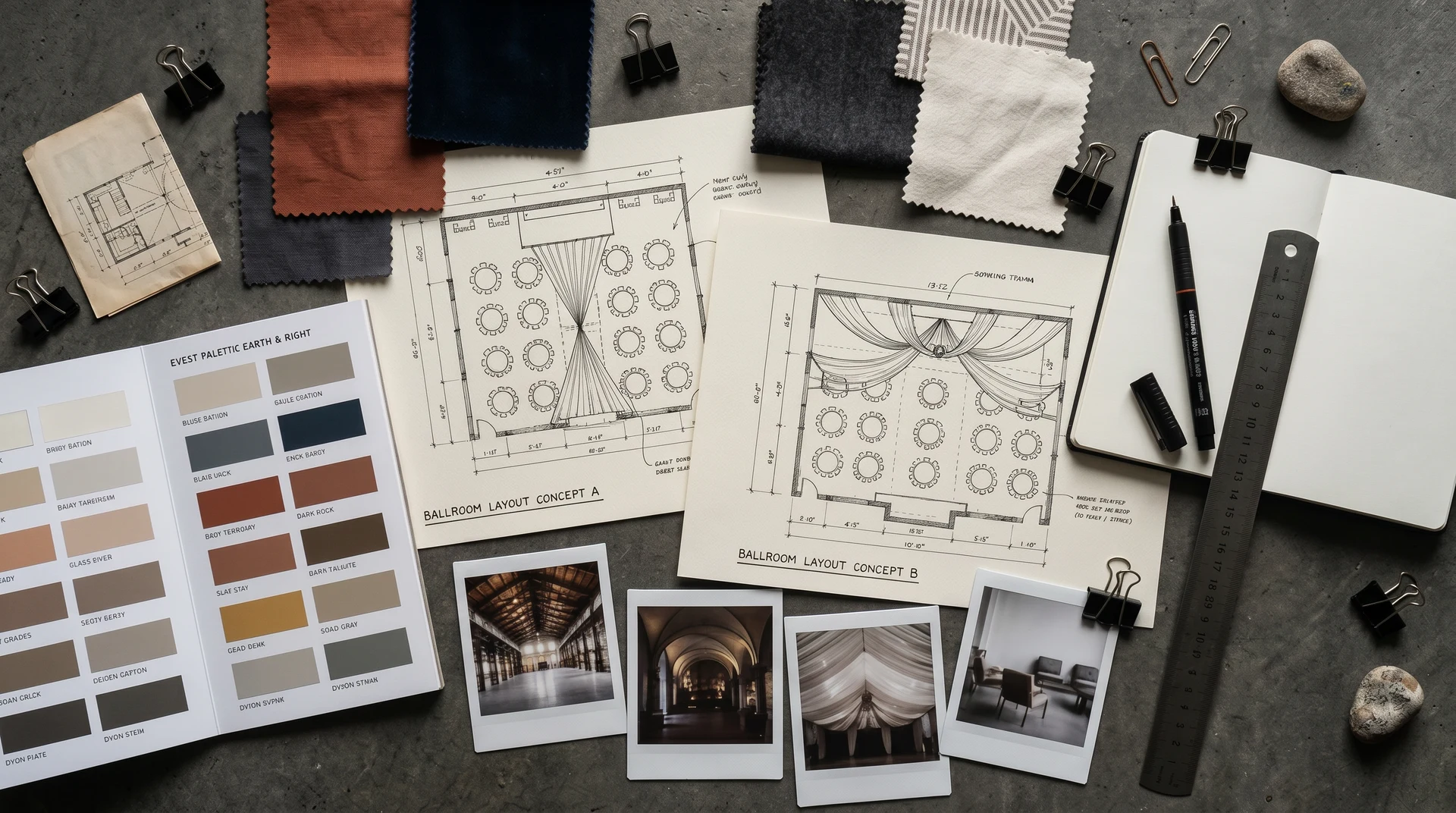
Event Design
vs. Event Planning:
What's the Actual
Difference?
- Event planning and event design are distinct disciplines. One manages the logistics of an event happening; the other shapes what the event looks and feels like.
- Many professionals do both, and do both well. The disciplines overlap in practice, even when they're cleanly separated in theory.
- The most effective events tend to have both functions working in sync, whether that's one person wearing both hats or two teams collaborating closely.
- A production company's job is to execute the design vision, whether that vision comes from the client, a planner, a designer, or all three together.
- If you're a planner who wants to deliver an exceptional environment for your clients, the right production partner can make you look like a design genius, without you having to build a fabrication shop.
Ask ten people in the events industry what the difference is between an event planner and an event designer, and you'll get ten different answers: some confident, some contradictory, a few that quietly reveal the person has been using the titles interchangeably for years. It's not a criticism. The two roles genuinely overlap, the industry doesn't enforce clean definitions, and plenty of talented professionals are legitimately both. But the disciplines are different, and understanding where they diverge can help you build a better team, set clearer expectations, and make smarter decisions about who does what on your next event.
Here's our honest take, from a production company that works alongside both planners and designers every week.
What Event Planning Actually Is
Event planning is fundamentally about orchestration. A planner's job is to ensure that an event actually happens: on time, on budget, with the right vendors in the right places and the right people in the right rooms. It's a logistics discipline as much as a creative one, and the skills it demands are project management, vendor coordination, timeline management, contract negotiation, budget tracking, and the ability to stay calm when three things go wrong simultaneously at 6pm on event day.
A skilled planner is the person who knows that the caterer needs load-in access two hours before the production crew finishes, that the AV vendor's power draw needs to be confirmed with the venue's electrician before the rental order is placed, and that the client's CEO will need a green room on the third floor because she never waits backstage with the other speakers. These are not small things. Events fall apart without someone whose entire focus is making sure they don't.
Planning is also deeply relational. A great planner carries relationships with venues, vendors, and clients that span years. Those relationships are often what gets a problem solved quietly at 7am before the client ever knows it existed.
Will this event actually happen the way it's supposed to? A planner's job is to make sure the answer is always yes, with three backup plans ready for when something tries to make it no.
What Event Design Actually Is
Event design is about the guest experience: the sensory and emotional environment you're creating for the people in the room. A designer's job is to answer the question: what does this event feel like? What does a guest experience the moment they walk through the door? What's the visual language of the room, the materials, the light, the scale, the color palette, the way the scenic elements relate to each other and to the space? What impression does this event leave?
This is a genuinely different skill set from planning. It draws on spatial thinking, an understanding of how materials and light behave in real environments, knowledge of what's actually buildable within a given budget, and the ability to translate a client's vague aspirations ("elegant," "immersive," "surprising") into specific, executable decisions about structure, fabric, light, and form.
A designer might spend hours considering how a 40-foot scenic backdrop will read from the back of a 500-person ballroom, or whether a ceiling installation needs to drop to 14 feet or 16 feet to feel intimate rather than oppressive. These aren't aesthetic preferences. They're technical decisions with real consequences for how a room feels.
"Planning asks: will this event happen? Design asks: when it happens, what will it feel like? Both questions matter. Neither one answers the other."
EventPro Production Brief
Where They Overlap
In practice, the line between planning and design is blurry, and that's not a problem. It's just reality. Many planners have strong design instincts and develop genuine expertise in the visual side of events over time. Many designers are deeply involved in the logistics of production because you can't design something without understanding how it gets built, delivered, and installed. And many independent event professionals do both, by necessity or by choice, and do both exceptionally well.
The overlap is especially pronounced in the middle of the market: smaller events, tighter budgets, clients who want a single point of contact. In those contexts, a planner who can also design, or a designer who can also manage logistics, is genuinely more valuable than two separate specialists.
Where the disciplines tend to separate more clearly is at the higher end: larger productions, more complex environments, clients with ambitious creative visions. At that level, the planning function is complex enough that it demands full attention, and the design function is specialized enough that it requires dedicated expertise and, critically, dedicated production infrastructure. You can't design a 30-foot custom scenic arch into existence through force of vision alone. Someone has to build it.
How the Roles Divide in Practice
This isn't meant to be a rigid taxonomy. It's a general map of how responsibilities tend to fall when both functions are present on a production:
| Responsibility | Typically: Planning | Typically: Design |
|---|---|---|
| Vendor Sourcing | Identifying, vetting, contracting | Specifying what vendors need to deliver |
| Timeline & Run of Show | Building and managing | Informing (load-in, install sequence) |
| Budget Management | Tracking overall spend | Managing design/production line items |
| Venue Relationship | Primary point of contact | Technical requirements, site survey |
| Creative Direction | Client input, mood board gathering | Concept development, design execution |
| Scenic & Environment | Coordinating install access | Designing and specifying what gets built |
| Guest Experience Arc | Program flow, arrival experience | Environmental storytelling, moment design |
| Day-of Command | Overall event management | Production install, design integrity |
Where Production Companies Fit
A production company like EventPro sits primarily on the design and execution side of this equation. We develop the creative concept, translate it into specific scenic, lighting, and environmental elements, build those elements in our facility, and install them in your venue. Our work begins where the floor plan ends. We're concerned with what the room looks and feels like once everyone's in it.
That said, we work with planners constantly, and those partnerships are some of our most effective productions. A strong planner handles the logistics ecosystem (venue, catering, entertainment, transportation, timeline) while we handle the environment. The client gets a cohesive team with clear ownership of each domain, and neither side is trying to do the other's job.
We also work directly with clients who don't have a planner, and in those cases we're more involved in the coordination layer, helping sequence vendors, flagging conflicts in the timeline, making sure the florist knows the ceiling rigging points before they submit their proposal. We're not planners, but we know how to function in that space when the situation calls for it.
If you have clients with ambitious design visions and you want to deliver on them without building an in-house fabrication operation, that's exactly what a production partnership is for. You bring the client relationship and the logistics expertise. We bring the design capability and the shop. Your clients get a better result. You look like a genius. It works.
What This Means for Your Next Event
If you're a client trying to staff an event, the most important thing isn't getting the titles right. It's making sure both functions are covered by someone who's genuinely good at them. Ask your planner how they handle the design side of events, and what their process is for working with production vendors. Ask your designer or production company how they coordinate with planners, and what information they need early to do their best work.
If you're a planner looking to expand what you can offer your clients, the most direct path is building relationships with production partners who can execute design work at a high level. You don't need to become a scenic designer. You need to know who can be yours. The best planner-production partnerships feel seamless to the client, even when they involve two separate organizations with entirely different areas of expertise.
And if you're a planner who genuinely does design your events, who develops concepts, directs the look and feel, and brings a real creative vision to the table, the right production partner will make your vision look better than you imagined it, and will make sure it actually gets built. That's the collaboration worth investing in.
← Back to The Production Brief
Work With Us
You bring the vision.
We'll build the room.
Planners and direct clients both. Tell us what you're working with.
Get a Quote →